Wednesday, February 4, 2015

WE LOVE COLOMBIA!

We just ended our 3-week South American adventure by spending the last 7 days in Colombia.  We flew from Cusco to Lima, and from Lima had to fly back to Panama City in order to catch our flight to Cartagena, Colombia.  We only had a brief layover in Panama City, just barely enough time to grab a quick bite to eat before our flight to Cartagena.  If felt a little strange to be back in Panama on a layover, knowing that we were not there to stay.  After feeling a little tired and having done some fairly rigorous traveling in Peru the last couple of weeks, it would have been easy for us to skip Colombia and head back home to Boquete, but we plunged forward and headed off to catch our flight to Colombia, and I'm so glad that we did because we LOVED it!

Cartagena de Indias sits on the Caribbean coast and its colonial area (El Centro) lies within the Walled City and is lively, with bright-colored buildings with flowered balconies, several small plazas, an assortment of small quaint hotels, and a plethora of fabulous restaurants, all which give this area a casual and artsy feel.  In our eyes, Cartagena is right up there with Antigua (Guatemala), Granada (Nicaragua), Cusco (Peru) and San Miguel de Allende (Mexico), but in many ways less touristy, and that, along with its cool Caribbean vibe make it even better.  

While in Cartagena, we strolled through the colonial area, visited El Castillo de San Felipe (San Felipe Castle - the largest Spanish fort in the New World), sampled some of the best ceviche we've ever had, and enjoyed taking in some of the Caribbean culture and influence of the area.

We have heard that the islands off Cartagena are beautiful and make a fun visit from the city, but didn't have time to check them out this time around.  After a short 2-night stay in Cartagena we headed to one of Colombia's well-known national parks, Parque Nacional Natural Tayrona.  We stayed for 4 nights at a small Bed & Breakfast a few minutes drive outside of the park and used it as our home base, making a day trip into the park, another day trip to nearby Quebrada Valencia (a beautiful waterfall), and a final day trip to Palomino (another great beach town).  

Parque Nacional Natural Tayrona was stunning with its white-sand beaches and massive boulders jutting out from the sand, all backed by beautiful palms, dense jungle, and the Sierra Nevada de Santa Marta which is the highest coastal mountain range in the world (up to 19,000 feet)!  The only drawback were the crowds, which unfortunately detracted from the natural beauty of the area.  Regardless, the trip was well worth it, and we feel fortunate to have visited these beautiful areas and to have seen a small part of Colombia's many beautiful and interesting destinations.

We liked Colombia, and visiting this country which was new to us, was a nice way to end our South American adventure.  The people are friendly, travel is easy, the food is great (far better than Panama's), and the culture is vibrant and interesting.  We know that Colombia has so much to offer and realize that we just got a small taste of it, being that we only saw part of its Caribbean coast.  If at all possible, we'd love to check out other areas before returning to California, and it's a huge bonus that Cartagena is just a short 45 minute flight from Panama City, making many Colombian destinations very accessible to us while we're here.  We'll see...


A view of Cartagena


Cartagena's busy streets, colonial charm, and fabulous architecture


El Centro - Cartagena's colonial area within the Walled City.


More bright colors and flowered-covered balconies...


Caribbean influence in Cartagena.  The fruit these women cut up for me was so fresh and delicious!


I'm always amazed to see how these women balance giant bowls of fresh fruit and homemade sweets on their heads as they walk through the city selling their goods.


A fabulous view from the rooftop of our Cartagena bed & breakfast


Another great view of Cartagena


Matt and Monica enjoy shaved ice after visiting El Castillo de San Felipe, one of our favorite sites in Cartagena.  This fortress, constructed during the colonial era, is said to be the most impressive ever built by the Spaniards in any of their colonies.


Castillo de San Felipe


Exploring the underground tunnels that led to the cells was fascinating, if not a little eery...


After spending just 2 nights in Cartagena, we took a 4-hour drive to Parque Nacional Natural Tayrona and stayed at this Bed & Breakfast (Villa Maria) just a few minutes drive outside of the park.  The downstairs restaurant served great food, and we stayed in the "family room" upstairs.


This is the beautiful beach, just a short walk from Villa Maria.


We arrived at Villa Maria in the afternoon and quickly headed to the beach, where Matt enjoyed kicking back in the sand, with the waves crashing in front of him.  Nice way to start out our time in the Tayrona National Park area!


The beach near Villa Maria had a great tropical feel to it, with a few thatched-roofed huts and traditional canoes, all backed by giant palm trees.


In the mornings, I enjoyed walking the long expansive beach near Villa Maria.  Unlike Parque Nacional Natural Tayrona (just a few minutes drive away), this beach was not filled with crowds.  In fact, while we were there, we rarely saw any people at all.


Greg and Matt spotted this gecko on the Villa Maria property.


They also found this big praying mantis (about 7 inches long).


Monica and Matt get a good night's sleep under their mosquito net at Villa Maria and enjoy sleeping in before eating eggs and arepas (a delicious thick Colombian pancake often filled with cheese or meat) for breakfast.


Palm trees were abundant along this part of Colombia's Caribbean coast.  


The walk to Quebrada Valencia, a beautiful waterfall in the area, was half the fun as we wondered through groves of banana and palm trees.


We came across this massive strangler fig along our way to Quebrada Valencia - pretty impressive!


Matt stands below the strangler fig.


Along our way to Quebrada Valencia, women were grilling arepas (cheese-stuffed corn pancakes), plantains, chorizo (sausages) and plantains with melted cheese.  By the end of the day, Matt had stopped at multiple stands and sampled quite a few arepas and chorizo.


Quebrada Valencia is certainly beautiful, but we arrived on a Sunday, and it was quite crowded.   Nonetheless, it was fun to see, and we enjoyed taking a quick swim to cool off and watching the locals jump off the higher rocks into the water below.


During our trip, we sampled some of the best ceviche, served Colombian style with fried corn kernels (cancha) and plantains.


This is one cool lizard!


One of our Colombian highlights was taking an all-day excursion to Parque Nacional Natural Tayrona.  We had the option of hiking through the park or going on horseback, and we decided to do a little of both.  On our way in we decided to go on horseback, and the ride was beautiful as our horses guided us along palm tree-lined paths to Tayrona's stunning beaches.


Parque Nacional Natural Tayrona is filled with these spectacular tall palm trees.  We loved hiking and riding horses along the paths from one beach to another.  


 Playa la Piscina - Parque Nacional Natural Tayrona


 Playa la Piscina - Parque Nacional Natural Tayrona


Kogi indians live up in the Sierra Nevada Mountains that border Parque Nacional Natural Tayrona.  Throughout our stay, we saw several Kogi indians in the area.  One of the managers at Villa Maria was very knowledgeable about the 4 different indigenous groups, and on our last day, was able to give us some great insights into the Kogi history, culture, and traditions.  The Kogi, who are descendants of the Tayrona people, are one of the few tribes that were never subjugated by the Spanish.  Originally, they lived on the coast, but when the Spanish arrived they retreated into the rugged Sierra Nevada and have retained their traditional farming culture and language to the present day.  Many of their villages prohibit the entry of outsiders, and most avoid any Western influence, including learning Spanish and attending schools.  


Matt and Monica at Parque Nacional Natural Tayrona


 Playa Cabo San Juan - Parque Nacional Natural Tayrona


The grainy sand is filled with brilliant specks of "fools gold".


Beautiful views at Parque Nacional Natural Tayrona - clear waters, white-sand beaches, endless palm trees, all backed by the Sierra Nevada mountains.


 Playa Arrecifes - Parque Nacional Natural Tayrona


Playa Arrecifes backed by jungle palms and the Sierra Nevada mountains


On our last day in the area we took one of the colectivos (small public bus) to Palomino, a small beach town with a friendly and laid-back vibe about a 40 minute drive from Villa Maria.  In this picture, Greg, Monica and Matt head to the beach along the dirt road, about a 20 minute walk from the bus stop. 


Passing a yuca plantation on our walk to Playa Palomino


It was fun to spend the day at Playa Palomino and to see another part of this Caribbean coastline.  


Beautiful Flower


After spending the day at Playa Palomino, we decided to take a "moto-taxi" back to the bus stop to catch our ride home - pretty fun!


It's time to leave Colombia and head back to Panama.  I wake up to the incredible view of this sunrise from the top floor of our bungalow at Villa Maria.  This is the perfect ending to a wonderful experience!

Friday, January 30, 2015

PERU - CUSCO AND MACHU PICCHU

We have continued our South American travels and just finished visiting Cusco and Machu Picchu.
After having spent a week in the northern part of Peru in the Amazon jungle, it was a nice change to head to the southern area of Peru.  The climate, people, language, foods, culture...etc. were so different from one another that it felt like we were in a different county altogether.

During our 3 nights and 2 days in Cusco we strolled around the city's many cobblestone streets, admired the colonial ambiance and architecture, sampled the local food, visited the ChocoMuseo (chocolate museum), and I even had a chance to visit Mercado de San Pedro and El Centro de Textiles Tradicionales del Cusco (a local women's weaving cooperative and museum).  Cusco sits at 11,200 feet, and it took us a day or two to adjust to the altitude.  Our hotel offered both mate de coca (coca tea) and oxygen to help one acclimatize.  We drank a lot of tea while there, and Monica and Matt each got a few oxygen treatments.  I'm not sure whether they really needed them, or if they just loved the experience of putting on the mask and receiving the oxygen?

Our most surprising event in Cusco was having to be evacuated from our hotel our very first morning because the hotel caught on fire.  Unfortunately, there was a fire started in the restaurant next door, and it ended up burning part of the roof of our hotel, creating a vast amount of smoke throughout the hotel.  It was an experience we will never forget, being summoned by the hotel staff in the early morning and quickly leaving the building (without our belongings) as smoke started to fill the rooms of the hotel.  Fortunately, no one was hurt, we ended up being transferred to another hotel for the remainder of our stay, and the event did not end up having a significant impact on our travel plans.  We just chalked it up as another one of our wild adventures...!

We took a day traveling from Cusco to Aguas Calientes, and spent time in the Sacred Valley, visiting the Pisac Ruins, Pisac Market, and the Ollantaytambo Ruins.  The scenery was beautiful and it was nice to see this area of Peru.  We then took the Vistadome train, from Ollantaytambo to Aguas Calientes in preparation for our Machu Picchu hike.  The 2 1/2 hour train ride along the Urubamba River was fabulous, and we enjoyed watching the vegetation change as we descended into the cloud forest of Aguas Calientes.  This was Monica's very first train ride, and she loved it!

Machu Picchu, Peru's 15th-century Inca site located at 7,970 feet above sea level, was quite impressive, especially after having visited the smaller ruins of Pisac and Ollantaytambo the day before.  We had a great experience, and are glad that we made the effort to see this incredible archaeological site.

After our long day at Machu Picchu, we took the Vistadome train back to Cusco, spent one last night, before we flew to Colombia, our next and final destination in our 3-week South American adventure.


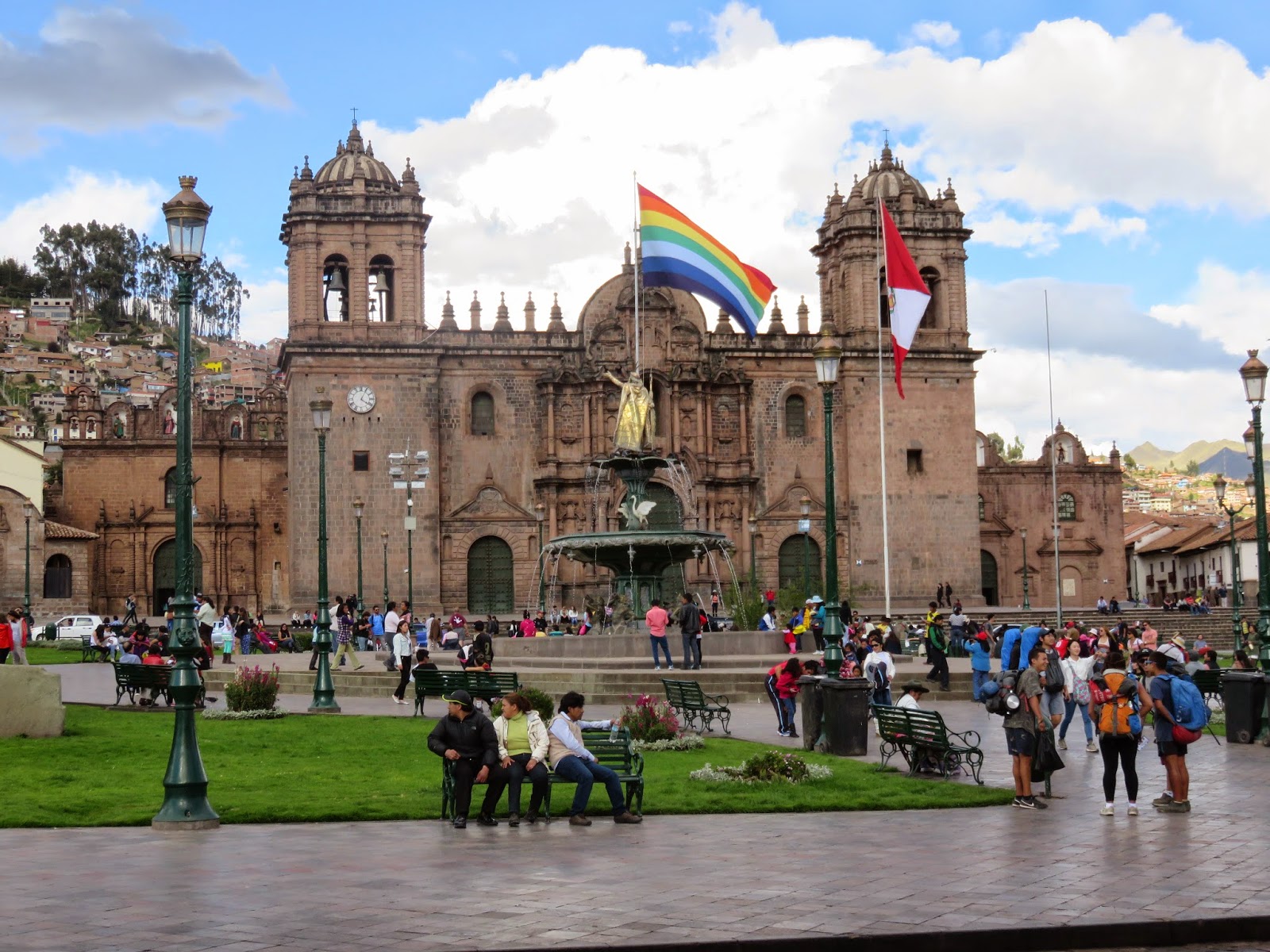
La Catedral in Cusco


Many women in Cusco weave their textiles and wear a traditional brown hat, as can be seen in this photo.


Beautiful churches and architecture in Cusco's Plaza de Armas


A view of Cusco and Plaza de Armas


Cuy (guinea pig) is one of Peru's traditional foods and many Peruvian's grew up eating it.  In recent years, it has become very expensive, unfortunately making it less available.  In Cusco, it is roasted in the oven and has a thick crunchy outer skin.  While there is not a whole lot of meat to be eaten, it can be quite delicious.  I personally prefer chicken or turkey over cuy, but had to try it while in Cusco.


These women from Chinchero, a village less than an hour away from Cusco, are wearing their brightly colored traditional clothing.


This young girl is weaving a scarf (by hand) in the Centro de Textiles Tradicionales de Cusco.  She lives in one of the small towns in the Sacred Valley.


This young girl is weaving (using a loom) in the Centro de Textiles Tradicionales de Cusco.  She also is making some type of garment to keep warm, and lives in one of the small towns in the Sacred Valley.


Monica and Matt are very excited to hold the lambs in Cusco!


Cusco's main market, Mercado Central de San Pedro, is located in a giant warehouse in the city.  Everything from fruits, vegetables, meats, grains, prepared foods, and textiles are sold here.  


Various types of corn (maiz), grains (quinoa), and spices are all sold in the market.  Cusco's food is delicious, and it we enjoyed sampling several new dishes.


We saw this Peruvian man with his animals.  The first two on the left are alpacas, and three on the right are llamas.  Many of the highest quality textiles in Peru are made of soft alpaca wool.


A gorgeous view of the Sacred Valley, with Rio Urubamba running through the middle


On our visit to the Sacred Valley we explored the ancient Pisac Ruins of the Incas. 


Monica and Matt at the Pisac Ruins


Beautiful Peruvian textiles are displayed and sold at the market in Pisac


Hand-woven Peruvian tapestries in bright colors are sold at the Pisac market


A women in Ollantaytambo, the Sacred Valley


The train ride through the Sacred Valley, from Ollantaytambo to Aguas Calientes, was gorgeous as we rode along the Urubamba River.


Some of the rapids on the Urubamba River were huge as we approached Aguas Calientes.


Aguas Calientes (AKA Machu Picchu town) is a quaint, but very touristy town situated on the raging Urubamba  River.  Everyone is here for the same reason, to visit Machu Picchu.  The landscape is lush and green, and the surrounding cloud-covered mountains are quite stunning.


While in Aguas Calientes, we stayed in a hotel with a lush and tropical setting.  Monica and Matt enjoyed a walk through one of the many beautiful paths along the Urubamba River.


These beautiful red flowers were seen throughout the hotel property.


Beautiful Cloud Forest Flower


Greg and I enjoyed watching the many hummingbirds.  These red-breasted beauties were amazing!


After an early morning breakfast, we took the bus ride from Aguas Calientes up to Machu Picchu.  The scenery along the bus ride itself was pretty spectacular, as we climbed the cloud-covered mountain, with the Urubamba River below.  


Machu Picchu had a magical feel to it, with the clouds rolling in and out as we explored the Inca ruins.


A View of Machu Picchu


Monica and Matt wear their alpaca domes and enjoy the view.  Matt makes a point of bringing a small notebook and draws pictures of the Machu Picchu ruins - so cute!


One of Monica's and Matt's favorite parts of our Machu Picchu visit was feeding the llamas.


A great view of Huayna Picchu, a massive peek (8,920 feet above sea level) that sits above Machu Picchu.  


Matt and Monica play a game of "Inca" chess on the Vistadome train ride after our long day visiting Machu Picchu.  A great way to end a very cool experience!